The Ultimate Guide

Collaborative Leadership

Leading a team today means something different than it did even a few years ago. People want to be involved in decisions that affect their work. They want a leader who brings out their best thinking, not one who just hands down direction. This page covers what collaborative leadership actually means, why it matters more than most leaders realize, what collaborative leaders do differently day to day, and how to build this capability in yourself or across your organization.

Collaborative Leadership

Introduction

Think about the best manager you ever had. Chances are they didn't have all the answers. What they did have was a way of pulling the right answers out of the people around them. They made you want to speak up in meetings. They trusted you with real decisions. You left conversations with them feeling more capable, not less.

That's collaborative leadership. It's a style of leading that treats the team as the source of good ideas, not just the group that executes someone else's. Leaders who build this muscle get better decisions, stronger buy-in, and teams that keep contributing long after the meeting ends.


What is Collaborative Leadership?

Collaborative leadership is an approach where the leader's job is to bring out the best thinking and effort of the people around them, rather than direct every move personally. A collaborative leader still sets direction, makes calls, and holds people accountable. What changes is how they get there.

Instead of relying purely on authority, a collaborative leader creates the conditions for people to contribute ideas, raise concerns, and take ownership of outcomes. They know when to step back and let the group work through a problem, and when to step in and make a decision. This is about getting more out of the people you lead by involving them well.

Interaction Associates calls this Facilitative Leadership, a term we use because the core skill is the same one we've taught facilitators since 1969: making it easier for people to think clearly, speak honestly, and act together.


Why Collaborative Leadership Matters

Leaders today face more complexity, faster change, and teams that expect more say in how work gets done. Command-and-control leadership doesn't hold up well under those conditions. A leader who has to personally solve every problem becomes a bottleneck. A team that only executes instructions can't adapt when the instructions stop being right.

Over 55+ years of teaching this skill set, we've seen the same pattern across industries: organizations with strong collaborative leadership move faster, not slower, because decisions don't have to travel up and down a chain of command every time something changes.

Without it, a few things tend to happen:

Leaders become the bottleneck. Every decision routes through one person, which slows everything down and burns that person out.

Teams stop contributing. When people are only asked to execute, they stop offering ideas. Over time, the leader loses access to information and perspective they need.

Change gets harder. Teams accustomed to being told what to do struggle to adapt when a leader needs them to think independently during a transition or crisis.

Good people leave. Talented employees want to be trusted with real responsibility. When they aren't, they look elsewhere.

Collaborative leadership addresses all of this by giving leaders a practical way to involve their team without losing control of outcomes.


What a Collaborative Leader Actually Does

A collaborative leader has a set of practices that can be learned. In practice, that means:

Sharing a vision people can act on. Rather than issuing instructions, a collaborative leader paints a clear enough picture of where the team is headed that people can make good decisions on their own when situations shift.

Balancing results, process, and relationship. It's easy to focus only on hitting the number. Collaborative leaders also pay attention to how the work gets done and how people treat each other along the way, because ignoring either eventually costs you the results too.

Involving the right people at the right moments. Not every decision needs full input from the whole team, and not every decision should be made solo. A collaborative leader reads the situation and chooses the right level of involvement for each one.

Building real agreement, not just avoiding objection. Silence in a meeting isn't buy-in. Collaborative leaders check for genuine commitment before moving forward, because half-hearted agreement leads to half-hearted follow-through.

Coaching instead of just directing. When someone comes to a collaborative leader with a problem, the leader's first instinct isn't to hand over the answer. It's to ask the questions that help the person find it themselves.

Recognizing contribution. Collaborative leaders notice and acknowledge good work regularly, not just at review time, because people put in more effort when they know it's seen.


The 7 Practices of a Facilitative Leader

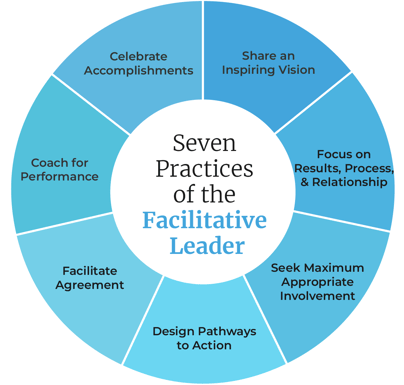
Facilitative Leadership, our flagship leadership program, is built around seven practices that leaders develop to tap the power of collaborative action.
7principles_FL_2

Share an Inspiring Vision. Communicate a picture of the future clear enough that people stay guided by it even when daily pressures narrow their focus.

Focus on Results, Process, and Relationship. Manage work using all three measures so the team produces results while staying productive and treating each other well.

Seek Maximum Appropriate Involvement. Make deliberate choices about who to involve in a decision and how, based on what will produce the best outcome and the strongest commitment.

Design Pathways to Action. Help the team see the routes to a goal and evaluate which one makes the most sense, rather than leaving the path unclear.

Facilitate Agreement. Model behavior that makes it safe for people to participate and disagree productively, so the group reaches real decisions instead of surface-level compliance.

Coach for Performance. Help people think for themselves, take risks, and grow, using listening and honest feedback instead of simply telling them what to do.

Celebrate Accomplishment. Recognize contributions as they happen. Authentic acknowledgment builds the pride and commitment that keeps people engaged.

These practices work together. A leader who's great at sharing vision but never celebrates contribution will still lose people over time. The goal is building all seven, not picking a favorite.


Key Concepts

Collaborative leaders create a safe environment for participation by modeling four related attributes: they encourage contribution and accept others' ideas without getting defensive, they keep the big picture in view and help the team focus on what matters most, they encourage initiative and distribute authority instead of hoarding it, and they create opportunities for people to work together toward outcomes that work for everyone involved.

Dimensions of Success
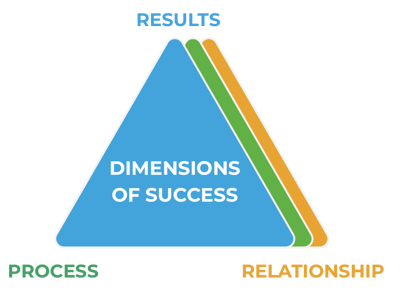
Leaders are usually held accountable for results, so that's where attention naturally goes. But results achieved through a broken process or damaged relationships rarely hold up. Collaborative leaders track all three dimensions: the outcome itself, how the team got there, and the state of the relationships along the way.
models_2026_rpr

Maximum Appropriate Involvement
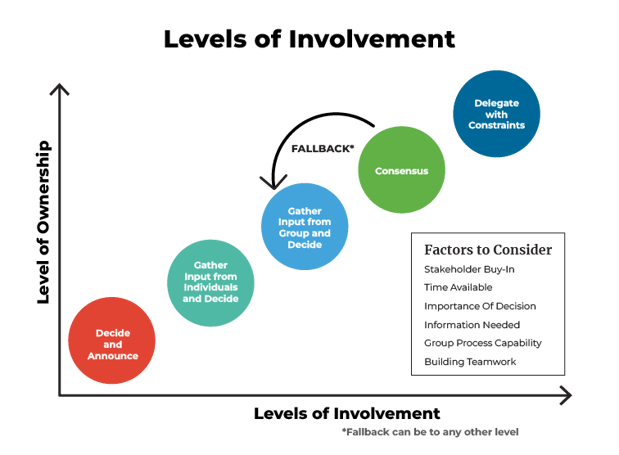
Not every decision needs a committee, and not every decision should be made alone. Collaborative leaders think deliberately about who needs to be part of a given decision and at what level, whether that's full participation, being consulted, or simply being informed. Getting this calibration right improves both the decision and the team's commitment to it.
models_2026_levelsofinvolvement

Building Agreement
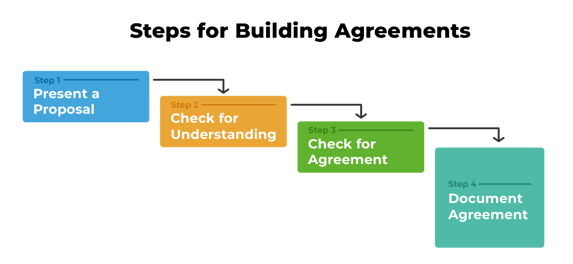
Real agreement means people can genuinely stand behind a decision, not just that no one objected out loud in the room. Collaborative leaders check for reservations, ask for specific commitments, and make sure the team understands the difference between "I can live with this" and "I'm actually on board."
models_2026_buildingagreements

Coaching Through Inquiry and Advocacy
When a team member brings a problem to a collaborative leader, the leader uses two tools: inquiry, to help the person uncover what they already know, and advocacy, to offer perspective when it's useful. The balance between the two is what separates coaching from simply solving the problem for them.


Who Benefits from Collaborative Leadership Training?

People managers who want their team to bring them solutions, not just problems, and who want meetings and one-on-ones that build real commitment rather than quiet compliance.

Project managers juggling stakeholders who don't report to them. Collaborative leadership gives PMs a way to lead through influence, not authority alone.

Executive sponsors and senior leaders navigating change, restructuring, or cross-functional initiatives where command-and-control approaches slow everything down.

L&D and HR professionals building leadership pipelines who need a practical, teachable framework rather than a personality-based idea of what makes a good leader.

Anyone leading through a transition, where the old playbook of direct instruction won't cover every situation the team will face.


Collaborative Leadership vs. Traditional Management

These get treated as the same thing, and they aren't.

Traditional management is largely about direction and oversight: assigning work, tracking progress, ensuring things get done on time and on budget. These fundamentals matter and collaborative leadership doesn't replace them.

Collaborative leadership adds a layer on top: how decisions get made, how much ownership the team feels, and how well people work together under pressure. A manager who's excellent at logistics but never involves the team in real decisions will still struggle to retain good people or adapt quickly. A leader who involves people well but ignores execution basics will struggle too.

The two work best together. Most people who talk about wanting "a better leader" are describing a gap in the collaborative side, not the logistical one.


Common Leadership Challenges

Letting go of control. Leaders who've built their careers on having the answer often find it uncomfortable to hand a decision to the team, even when it would produce a better outcome. This is a mindset shift more than a skill gap.

Involving people without losing momentum. Overcorrecting toward inclusion can slow decisions to a crawl. Collaborative leaders learn to calibrate involvement to the stakes and timeline of each decision, not apply the same process to everything.

Balancing authority with collaboration. A leader is still accountable for the outcome, even when the team drove the decision. Being transparent about when you're stepping into a decision-maker role versus a facilitator role keeps this clear for everyone.

Coaching instead of fixing. It's often faster in the moment to just give someone the answer. Coaching takes longer up front and builds a stronger team over time. Leaders under time pressure default back to fixing unless they've built the habit deliberately.


Building a Collaborative Leadership Culture

One leader practicing this well helps their own team. An organization full of them changes how the whole place operates. That looks like managers at every level who default to involving their teams appropriately, who build genuine agreement instead of settling for silence, and who coach rather than just direct.

Organizations that build this broadly report faster decision-making, stronger retention, and teams that adapt more easily to change, not because every leader became a professional facilitator, but because the underlying practices spread widely enough to shift how people expect to work together.


How Interaction Associates Approaches Collaborative Leadership

Interaction Associates has taught collaborative leadership since 1969 through the Interaction Method™. Our flagship program, Facilitative Leadership™, teaches the practical skills behind it through a mix of framework content and live practice on real challenges participants are currently facing.

Facilitative Leadership is available in-person over three days or live-online across eight two-hour sessions, and qualifies for up to 24 PDUs from the Project Management Institute. Graduates leave with tools they can use in their next team conversation, not just concepts they read about.

For organizations building this capability broadly, we also offer Train-the-Trainer certification so internal leaders can bring Facilitative Leadership to teams across the company.


Frequently Asked Questions

Is collaborative leadership the same as consensus-based leadership? 
No. Consensus means everyone has to agree before moving forward, which can slow decisions dramatically. Collaborative leadership means involving people appropriately and building real commitment, but the leader still makes the call when a call needs to be made.

Does collaborative leadership work in a crisis or under time pressure?
Yes, though the practices look different. Under pressure, a collaborative leader might involve fewer people or move faster through the agreement-building process, but they're still communicating a clear vision and coaching the team through the moment rather than just barking orders.

What's the difference between coaching and managing? 
Managing focuses on assigning and tracking work. Coaching focuses on developing someone's own thinking and capability. Collaborative leaders do both, using coaching in the moments where building the person's capability matters more than getting a quick answer.

How long does it take to build these skills?
Leaders can build a working foundation in a focused multi-day program with live practice. Like any leadership skill, fluency comes from applying it in real team situations afterward. Every team conversation is a chance to practice.


Interaction Associates has been teaching collaborative leadership since 1969. We've trained over a million people across hundreds of organizations worldwide.

Learn more at interactionassociates.com or reach out at success@interactionassociates.com