Group Facilitation
Managing the meeting room filled with differing opinions and personalities can be a challenge. This page will walk you through group facilitation, definitions of common terms and techniques to use when you facilitate meetings.

Table of Contents
Introduction
If you've ever sat through a meeting where three people talked over each other, nothing got decided, and everyone left with a different understanding of what just happened, you've experienced what happens when group facilitation is absent.
Group facilitation is the practice of guiding a group through a conversation, decision, or collaborative process so they can reach a genuine outcome together. Facilitators make it easier for people to think clearly, actually hear each other, and act with a shared direction.
This page covers what group facilitation is, why it matters more than most organizations realize, what skilled facilitators do differently, and how to build this capability yourself or within your teams.
What is Group Facilitation?
Group facilitation is the process of helping a group work together more effectively. A facilitator designs and guides the process of a meeting or working session. They'll often do this with a key stakeholder, meeting leader, or other leader responsible for the outcomes of a given meeting. Once this is agreed upon, the facilitator is the one responsible for managing what the group will do, in what order, and how without advocating for any particular outcome, as the facilitator is generally considered neutral. This isn't always the case in smaller, more general meetings. Your group facilitator can be an internal person who is also a stakeholder in the conversation.
When it comes to larger meetings with higher stakes, bringing in a third party (neutral) group facilitator is important so that all attendees can focus on the content of the meeting and not facilitating the room.
The word "facilitation" comes from the Latin "facilis": to make easy. The job of the facilitator is to make it genuinely easier for a group of people to understand each other, build agreement, and decide what to do next.
Facilitation applies across meeting types: planning sessions, decision-making meetings, problem-solving workshops, team retrospectives, strategy offsites, cross-functional alignment sessions. Any time a group needs to think together, facilitation is the discipline that helps them do it well.
Why Group Facilitation Matters
Most organizations have a meeting problem. In fact, US professionals lose a reported $259 billion per year in unproductive meetings. Meetings are where work gets decided, planned, and committed to, but they're also where time disappears, alignment breaks down, and momentum stalls.
Over our 55+ years of teaching facilitation best practices, we've found that the root cause almost always comes down to the facilitated process, but the blame is always the people in the room.
Without facilitation, a few things reliably happen:
Loudest voices win
The most dominant person in the room shapes the outcome, regardless of whether their perspective is the most informed or the most broadly supported.
Problems stay surface-level
Without a structure that invites people to go deeper, groups tend to agree on the first plausible solution rather than the right one.
Decisions don't stick
When people don't feel heard in the process, they don't own the outcome. They comply in the meeting and resist in implementation.
Time gets wasted
Without a clear process, conversations circle. Topics get reopened. Meetings end without actionable next steps, which means scheduling another meeting to redo the work.
Skilled facilitation prevents all of this by giving the group a clear, shared process that everyone can trust.
What a Facilitator Actually Does
A facilitator's job is to manage the process so the group can focus on the content. That means:
Setting clear outcomes before the meeting starts
The common misconception of an appropriate meeting agenda is that it's simply a list of topics, or that listing these topics is enough. An effective meeting agenda provides specific articulation of what the group needs to leave with. Our most popular training, Essential Facilitation™ teaches you how to build a structured meeting agenda.
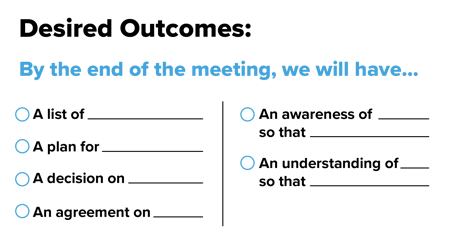
One simple practice from this training is ensuring that each desired outcome you write answers the question "What will we achieve by the end of this meeting?" These desired outcomes give the group a clear destination rather than simply a general direction.

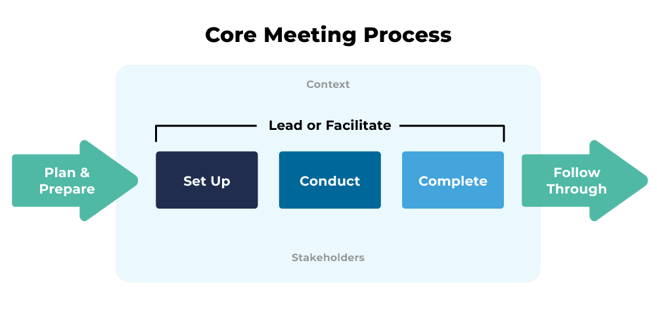
Designing the meeting process
A facilitator is responsible for deciding how the group will move through each topic, what questions they'll address, in what order, and using what methods. A facilitator thinks about this before walking into the room. But, they must also be able to pivot in the moment.
They might notice that the meeting is getting derailed or maybe there's another issue that should be solved for that wasn't originally accounted for. A meeting agenda is a roadmap in which you can deviate when a situation calls for it. A facilitator must be able to spot these moments and pivot in the moment.
Keeping the discussion productive
This includes things like ensuring everyone has an opportunity to contribute, keeping the conversation on track when it drifts, surfacing ideas that are in the room but haven't been said, and helping the group recognize when they've reached a decision vs. when they're still exploring.
Building real agreements
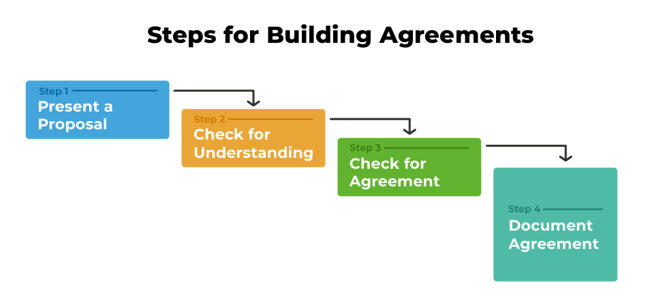
A skilled facilitator checks for genuine alignment by surfacing reservations, testing commitment, and making sure people can actually stand behind what they've agreed to.
Managing the unexpected
Conflict surfaces. Someone derails. The group gets stuck. A facilitator knows how to recognize these moments and navigate them without shutting people down or losing the thread.
The Interaction Method™
Interaction Associates introduced group facilitation to the business world in 1969. The framework we've taught to over a million people since then is called the Interaction Method™.
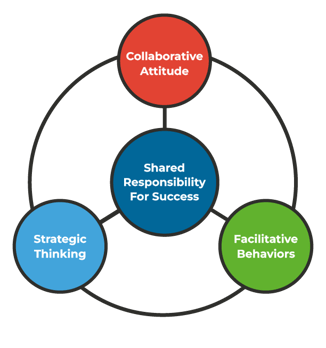
At its core, the Interaction Method is built on four elements:
Collaborative Attitude
The belief that the group is the best source of answers for complex problems. A facilitator holds this orientation even when the group is struggling.
Strategic Thinking
The ability to track where the group is in its process, recognize when something has shifted, and ask the right question at the right moment. This is the core intellectual work of facilitation.
Facilitative Behaviors
The specific practices that move a group forward. Techniques like paraphrasing to confirm understanding, asking open questions to surface new ideas, checking for agreement before moving on.
Shared Responsibility for Success
The best facilitated sessions are ones where group members have internalized enough about how good conversations work that they help each other stay on track.
Together, these four elements create the conditions for groups to do their best thinking together.
Key Concepts
Desired Outcomes
The single most important thing a facilitator does before a meeting is define the desired outcomes — specific, measurable descriptions of what the group will have produced by the end of the session.
Desired outcomes are written as nouns, not verbs. Not "discuss the budget" but "a shared understanding of Q3 budget constraints and a prioritized list of tradeoffs." The difference sounds small. In practice it changes how the facilitator designs the session and gives the group a way to know whether they've finished.
Open, Narrow, Close
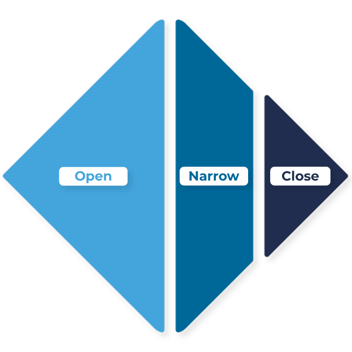
Most productive discussions follow a three-stage structure: opening up the conversation to surface ideas and perspectives (open), working to identify priorities and test different options against each other (narrow), and reaching a clear conclusion or decision (close).
Skilled facilitators track which stage a group is in and help them move through all three. Groups frequently get stuck in the open stage when they're generating ideas without ever committing to any of them. Others try to close before they've actually opened, jumping to decisions before the room has shared enough.
Decision-Making Methods
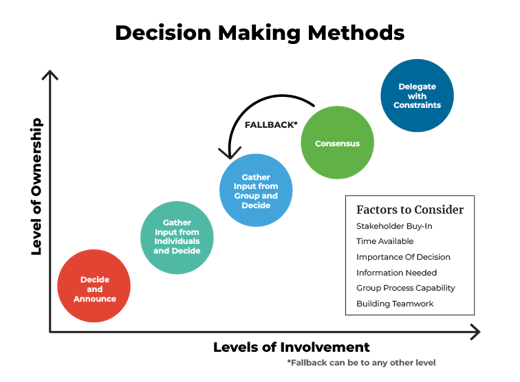
One of the most common sources of confusion in meetings is that nobody is clear on how a decision will actually get made. Is this a consensus decision? Does the most senior person in the room decide? Is this purely informational?
A facilitator makes the decision-making method explicit before the conversation starts. This does several things: it sets appropriate expectations, it allows people to engage at the right level of investment, and it prevents the frustrating experience of participating in a long discussion only to discover that one person was going to decide anyway.
Common decision-making methods include: leader decides (with or without input), majority vote, and consensus. Each has appropriate uses. The facilitator's job is to help the group choose the right one for the situation.
Building Agreements
Agreement in a meeting isn't the same as the absence of objection. A skilled facilitator checks for genuine alignment by explicitly testing for reservations, asking for specific commitments, and helping the group distinguish between "I can live with this" and "I'm fully behind this."
This matters because half-hearted agreements produce half-hearted follow-through. When people genuinely commit to a decision, implementation is faster and more consistent.
Strategic Moments
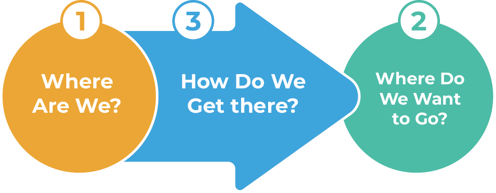
In any meeting, there are moments when the group is at a choice point, when the path forward isn't obvious and the next step could go several different directions. These are called strategic moments.
Skilled facilitators recognize these moments and help the group navigate them by asking three questions: Where are we now? Where do we want to go? How do we get there? This simple framework gives any group a way to self-correct when they get stuck.
Who Benefits from Facilitation Training?
Group facilitation is often associated with formal facilitators. These are people whose job it is to design and run workshops or large group processes. But the truth is that facilitation skills are valuable for anyone who leads or participates in meetings regularly.
Team leaders and managers who run weekly team meetings, one-on-ones, and project reviews. The ability to design a meeting with clear outcomes, keep discussion focused, and build genuine agreement makes these sessions significantly more productive.
Project managers who are constantly coordinating across stakeholders with competing priorities. Facilitation gives PMs the tools to run kickoffs that create real alignment, status reviews that surface problems early, and planning sessions that produce commitments people actually keep.
L&D and HR professionals who design and deliver training, facilitate workshops, or support team effectiveness initiatives. Facilitation skills are foundational to doing this work well.
Consultants and change agents who are helping organizations navigate complex decisions or transitions. The ability to guide a group through uncertainty without imposing a predetermined answer is one of the most valuable capabilities a consultant can have.
Anyone who leads high-stakes conversations, cross-functional decisions, sensitive team dynamics, strategic planning, or any situation where the quality of the conversation determines the quality of the outcome.
Facilitation vs. Meeting Management
These terms often get used interchangeably. They're not the same thing.
Meeting management is about logistics: having an agenda, starting on time, keeping notes, sending a recap. These things matter. But they don't, on their own, ensure that the group produces anything meaningful.
Group facilitation is about the thinking process: helping a group surface the right information, work through genuine disagreement, and arrive at decisions with shared ownership.
A well-managed meeting can still be a waste of everyone's time if the facilitation is absent. A facilitator who ignores logistics is also going to struggle. But when people talk about wanting better meetings, what they almost always mean is that they want better facilitation — more focused, more honest, more decisive.
Common Facilitation Challenges
Dominant participants
In most groups, a few people tend to dominate the conversation. This isn't always malicious. Some people just process out loud, or feel more comfortable speaking. But it consistently produces decisions that reflect a subset of the room's knowledge and perspective.
A skilled facilitator designs for this before it becomes a problem. They build in processes that invite broader participation, create space for written input before open discussion, and use techniques that give quieter participants an entry point.
Getting stuck
Groups get stuck when they're trying to narrow or close before they've fully opened or when they keep opening long after they have enough information to move forward. Recognizing which problem you have is half the battle. The fix for a group that's circling without deciding is different from the fix for a group that jumped to a solution too fast.
Unspoken concerns
Some of the most important information in any meeting is what doesn't get said. Reservations, disagreements, competing priorities that nobody wants to surface in front of leadership. A facilitator creates the conditions where this information can come out. They build enough psychological safety and structure that people feel willing to be honest.
Facilitating with authority
One of the most common challenges for leaders is facilitating a group in which they also have a stake in the outcome. The pull to advocate for your own position while still being responsible for managing the process fairly is real.
The answer is to be transparent when you're shifting roles: "I want to step out of the facilitator role for a moment and share my perspective on this." Naming the shift is what makes it legitimate.
Building a Facilitation Culture
Individual facilitation skills matter. But the highest-leverage thing an organization can do is build a culture where facilitation practices are widespread. A culture where leaders at multiple levels can design and run effective group processes, and where teams have shared norms around how they conduct their meetings.
This looks like: leaders who routinely state desired outcomes before a discussion, teams that explicitly choose how a decision will get made before diving into it, and a general expectation that meetings end with specific commitments, not vague intentions.
Organizations with strong facilitation cultures report better cross-functional alignment, faster decision-making, and significantly more productive meetings. Not because everyone is a professional facilitator, but because the basic practices have spread broadly enough to change how the organization operates.
How Interaction Associates Approaches Group Facilitation
Interaction Associates has been teaching the Interaction Method™ since 1969. Our flagship program, Essential Facilitation™, teaches the core skills of group facilitation through a combination of framework content and live facilitation practice.
Participants practice real challenges they're currently facing, receive direct feedback, and leave with tools they can apply in their next meeting.
Essential Facilitation is available in-person and live-online. It also qualifies for up to 24 PDUs from the Project Management Institute making it particularly relevant for project managers looking to develop their facilitation capabilities alongside their PM credentials.
For organizations looking to build broader facilitation capability, we also offer Train-the-Trainer certification so your internal facilitators can bring the Interaction Method to teams across your organization.
Frequently Asked Questions
What's the difference between a facilitator and a moderator?
A moderator typically manages the flow of a conversation by keeping time, calling on speakers, enforcing rules of engagement. A facilitator does all of that, but also actively designs and shapes the process to help the group produce a quality outcome. Facilitation is a more active, more skilled role.
Do you need a professional facilitator for every meeting?
No. Most meetings benefit from one person taking on the facilitator role, but that person doesn't need to be a professional. What they need is a basic toolkit: the ability to define desired outcomes, choose an appropriate process, keep the conversation productive, and build agreements. These are learnable skills.
What makes a good facilitator?
Skilled facilitators are genuinely curious, comfortable with ambiguity, and able to hold a neutral orientation even under pressure. They're focused on helping the group accomplish something real. The technical skills (process design, intervention techniques, agreement-building) can be taught. The underlying orientation like service to the group over advocacy for a position is what separates good facilitation from group management.
How long does it take to develop facilitation skills?
Basic facilitation skills can be developed meaningfully in a few days of focused training with live practice. Building fluency with the ability to read a room, recognize strategic moments, and intervene with confidence takes ongoing practice. Facilitation is a skill with a fast feedback loop: every meeting is an opportunity to apply and refine what you've learned.
Related Topics
- What is Essential Facilitation™?
-
What is Facilitative Leadership™?
-
How to Run a Meeting with Clear Outcomes
-
Decision-Making Methods: A Practical Guide
Interaction Associates has been teaching the practice of group facilitation since 1969. We've trained over a million people across hundreds of organizations worldwide.
Learn more at interactionassociates.com or reach out at success@interactionassociates.com
Get our free ebook on how you can level up your B2B SaaS content marketing
Resources and frameworks for your digital marketing approach
How to build B2B SaaS landing pages that actually convert
Well crafted landing pages pay dividends. They’re often made out to be an enigma but don’t need to be complicated.